THANK YOU FOR SUBSCRIBING


× 
Construction Tech Review Weekly Brief
Be first to read the latest tech news, Industry Leader's Insights, and CIO interviews of medium and large enterprises exclusively from Construction Tech Review





Kpmg Builds With Innovation To Inspire Creativity And Learning
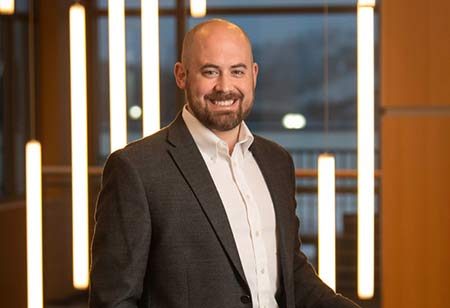
Fred Battista, Senior Vice President, JLL And Bill Flemming, Managing Director Of Real Estate Services, KPMG
 Fred Battista, Senior Vice President, JLL And Bill Flemming, Managing Director Of Real Estate Services, KPMG
When KPMG set out to create a state-of-the-art learning, development and training environment, it envisioned far more than just classrooms. Rather, the goal was to create an engaging, energizing experience to inspire innovation and human performance in preparation for the future of work.
The result? The $450 million KPMG Lakehouse learning and innovation center, a 55-acre campus comprising not only conference and training facilities, but also 800 guest rooms, fitness and outdoor recreational facilities, and multiple food and beverage venues. To foster collaboration and innovation, the campus provides a rich multi-sensory experience and sense of discovery drawn from the natural environment—think human-scale curving halls and walkways; natural daylight and views; and varied spaces.
Headquartered out of Chicago, and known as one of the Big Four auditors, KPMG constructed its new center on a 55-acre campus in Lake Nona, Florida. The new facility expands KPMG’s training capabilities for staff and clients and is slated to open in early 2020.
As visitors experience the center’s multifaceted classrooms and amenities, what they won’t see are the innovative construction strategies used to develop the world-class facility on a rapid and compressed time schedule.
To develop the complex project as efficiently as possible, KPMG assembled a team comprising JLL Project and Development Services, DPR Construction and Gensler, a design and architecture company.
One creative strategy was to manufacture key energy infrastructure components offsite, rather than constructing the components onsite after the building shell was complete. For instance, the electrical equipment—including switchgear, switchboards, panel boards and transformers—was assembled on a single skid and tested before delivery to the site. Once delivered, the only remaining tasks were to connect the incoming and outgoing wiring.
Similarly, the central energy plant was manufactured as a fully modular system, comprising three 900-ton chillers, three chilled-water pumps, three condenser water pumps, filter system, and all the electrical components, controls and piping to support an entire chilled water system. After being assembled at an offsite factory, the plan was shipped to the construction site in four sections and simply dropped into place.
Curtainwall units also were engineered and assembled offsite, reducing the onsite labor and associated costs of installation. Through design-assist procurement, based on a target value for the design, the team was able to meet both the design and budgetary goals for the curtainwalls.
In addition, bathroom “pods” for the campus hotel were procured from a single source, rather than from an array of dozens of vendors and suppliers. Single-source procurement also reduced construction time and labor costs, because most of the bathroom pods were installed before the building was even topped out.
Given that bathrooms typically constitute 80% percent of hotel room buildout costs, the cost savings were significant. AlsoMoreover, important, the pods exceeded quality expectations because they were produced in a controlled manufacturing environment.
To further save time and reduce costs, the project team used Lean construction techniques and high-tech tools that also improved the accuracy of the design and construction drawings. For example, the team used cloud-based Autodesk BIM 360 Glue to accelerate planning and collaboration on iPads, and StructionSite for sharing progress documentation in the field. With Skycatch cloud-based software, the team combined images captured by drone into single images for construction review.
As interiors were constructed, the team used Never Miss technology to accelerate drywall finishing, and a PanelMax drywall fabrication machine that eliminated the need to apply beading on outward-facing drywall corners.
Built on innovation from the inside out, the new KPMG Lakehouse will offer the company’s 32,000 employees a place to be inspired, recharge, reconnect and refocus on new challenges and opportunities. When the campus opens in January 2020, clients and other companies will be able to send their employees for training, or to work with KPMG teams in an innovation lab to solve their toughest challenges. The center promises to set an example for how businesses can help prepare workers to adapt in a world where many of the jobs that will exist in 10 years haven’t been invented yet.

Read Also

Reframing Application Engineering for the Digital Age
Mark H. Wayne, PhD, PE, F. ASCE, Director of Application Technology & Engineering, Tensar, a division of CMC

The Human Side of Construction Safety Leadership
Brett Smith, Global Safety Director, Gardner Builders

Leading with Safety at Scale: A Practical Approach to Risk Management in Construction
Donovan Seeber, CHST, Corporate Safety Manager, Griffith Company

Engineering Roadway Design with Accountability and Vision
Maria Luchey, Project Manager, Roadway Design, Keck & Wood
How Early VDC Involvement Reduces Risk and Rework on Complex Projects
Nicholas DiRenzo, Virtual Design & Construction Director, Meyer Najem

Coaching, Not Blaming: Building a Stronger Construction Safety Culture
Jesse Garcia, Safety Manager, E-Z Bel Construction, LLC


 Copyright © 2026 All Rights Reserved | by:
 Construction Tech Review
| Subscribe | About us | Sitemap| Editorial Policy| Feedback PolicyTop
