
THANK YOU FOR SUBSCRIBING
× 
Construction Tech Review Weekly Brief
Be first to read the latest tech news, Industry Leader's Insights, and CIO interviews of medium and large enterprises exclusively from Construction Tech Review


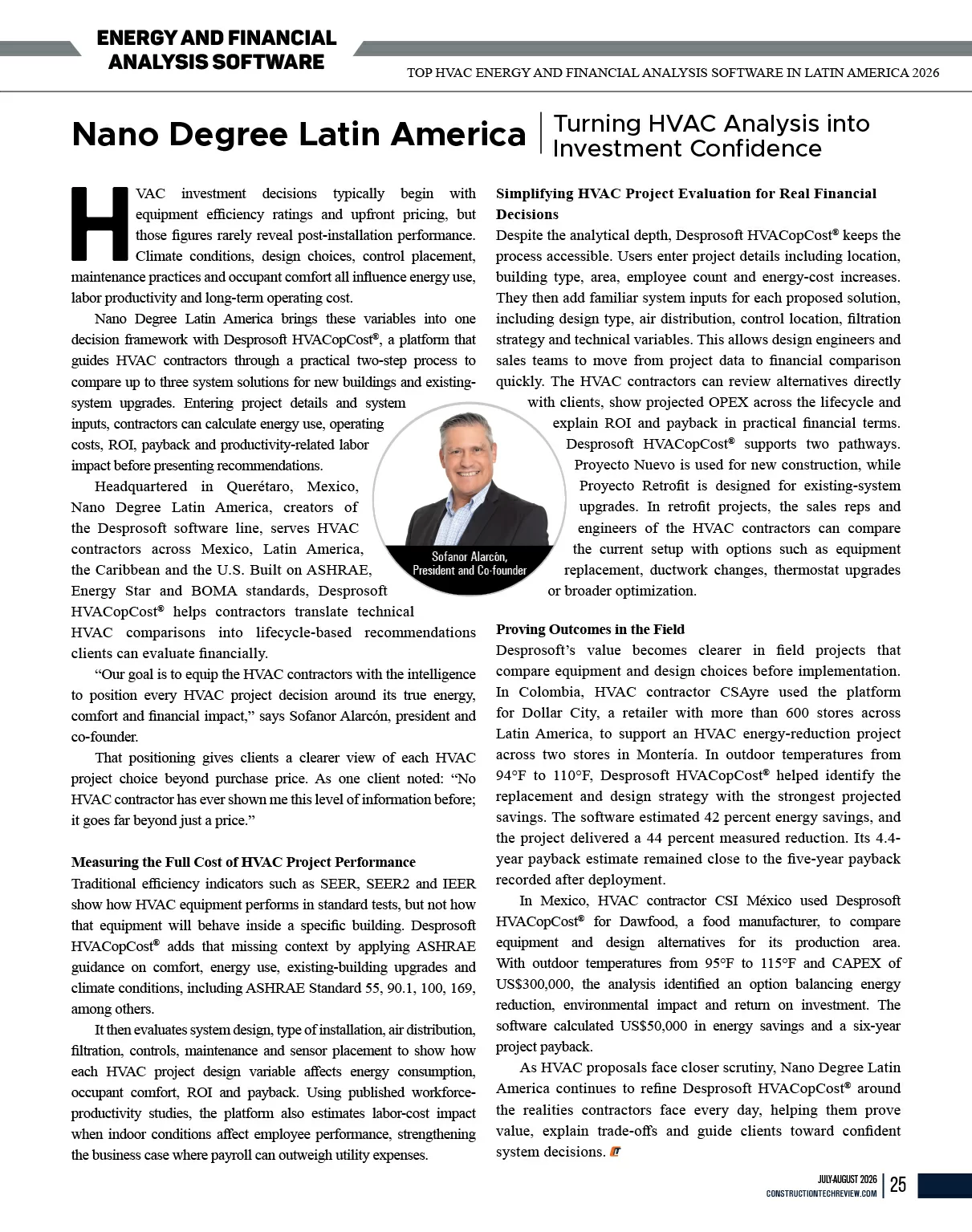
 Sofanor Alarcón, President and Co-founder
Nano Degree Latin America brings these variables into one decision framework with Desprosoft HVACopCost®, a platform that guides HVAC contractors through a practical two-step process to compare up to three system solutions for new buildings and existing-system upgrades. Entering project details and system inputs, contractors can calculate energy use, operating costs, ROI, payback and productivity-related labor impact before presenting recommendations.
Headquartered in Querétaro, Mexico, Nano Degree Latin America, creators of the Desprosoft software line, serves HVAC contractors across Mexico, Latin America, the Caribbean and the U.S. Built on ASHRAE, Energy Star and BOMA standards, Desprosoft HVACopCost® helps contractors translate technical HVAC comparisons into lifecycle-based recommendations clients can evaluate financially.
“Our goal is to equip the HVAC contractors with the intelligence to position every HVAC project decision around its true energy, comfort and financial impact,” says Sofanor Alarcón, president and co-founder.
That positioning gives clients a clearer view of each HVAC project choice beyond purchase price. As one client noted: “No HVAC contractor has ever shown me this level of information before; it goes far beyond just a price.”
Measuring the Full Cost of HVAC Project Performance
Traditional efficiency indicators such as SEER, SEER2 and IEER show how HVAC equipment performs in standard tests, but not how that equipment will behave inside a specific building. Desprosoft HVACopCost® adds that missing context by applying ASHRAE guidance on comfort, energy use, existing-building upgrades and climate conditions, including ASHRAE Standard 55, 90.1, 100, 169, among others.
It then evaluates system design, type of installation, air distribution, filtration, controls, maintenance and sensor placement to show how each HVAC project design variable affects energy consumption, occupant comfort, ROI and payback. Using published workforce-productivity studies, the platform also estimates labor-cost impact when indoor conditions affect employee performance, strengthening the business case where payroll can outweigh utility expenses.
Simplifying HVAC Project Evaluation for Real Financial Decisions
Despite the analytical depth, Desprosoft HVACopCost® keeps the process accessible. Users enter project details including location, building type, area, employee count and energy-cost increases. They then add familiar system inputs for each proposed solution, including design type, air distribution, control location, filtration strategy and technical variables. This allows design engineers and sales teams to move from project data to financial comparison quickly. The HVAC contractors can review alternatives directly with clients, show projected OPEX across the lifecycle and explain ROI and payback in practical financial terms. Desprosoft HVACopCost® supports two pathways. Proyecto Nuevo is used for new construction, while Proyecto Retrofit is designed for existing-system upgrades. In retrofit projects, the sales reps and engineers of the HVAC contractors can compare the current setup with options such as equipment replacement, ductwork changes, thermostat upgrades or broader optimization.
Proving Outcomes in the Field
Desprosoft’s value becomes clearer in field projects that compare equipment and design choices before implementation. In Colombia, HVAC contractor CSAyre used the platform for Dollar City, a retailer with more than 600 stores across Latin America, to support an HVAC energy-reduction project across two stores in Montería. In outdoor temperatures from 94°F to 110°F, Desprosoft HVACopCost ® helped identify the replacement and design strategy with the strongest projected savings. The software estimated 42 percent energy savings, and the project delivered a 44 percent measured reduction. Its 4.4-year payback estimate remained close to the five-year payback recorded after deployment.
In Mexico, HVAC contractor CSI México used Desprosoft HVACopCost ® for Dawfood, a food manufacturer, to compare equipment and design alternatives for its production area. With outdoor temperatures from 95°F to 115°F and CAPEX of US$300,000, the analysis identified an option balancing energy reduction, environmental impact and return on investment. The software calculated US$50,000 in energy savings and a six-year project payback.
As HVAC proposals face closer scrutiny, Nano Degree Latin America continues to refine Desprosoft HVACopCost® around the realities contractors face every day, helping them prove value, explain trade-offs and guide clients toward confident system decisions.
Selecting HVAC Energy and Financial Analysis Software in Latin America
For commercial and industrial facilities in Latin America, investing in HVAC systems requires much more than just calculating the efficiency rates of equipment in technical terms anymore. Rising energy volatility, decarbonization efforts, increasing labor costs, and tighter capital discipline have made climate-control decisions part of enterprise financial planning. Decision-makers evaluating HVAC energy and financial analysis software need not only a calculation tool comparing efficiencies but a tool allowing turning technical alternatives into cost, comfort, and ROI estimates before capital is committed.
Latin American markets complicate the situation, making decision-making tools work harder. Climate varies dramatically between coastal, tropical, high-altitude, and mixed urban environments in the region. Utility prices, escalation rate assumptions, and building profiles vary from country to country and sometimes from city to city.
A tool considering HVAC performance as the efficiency rate of the equipment used might lead managers to erroneous estimates since energy consumption depends on system design, control, air distribution, filtration, installation quality, and maintenance procedures. Energy Use Intensity and consumption per area are performance measures applicable only when taking into account the particular building environment and not some generic laboratory rating. This becomes extremely important in Latin America when managing the problem of inconsistent utility data, mixed building stock, and varying technical documentation across the markets.
Financial clarity is equally important. HVAC systems proposals compete against other capital projects, which makes it necessary to consider the impact of each option on operational expenses, payback, ROI, and future budget exposure. The best decision-making platforms allow engineering teams to model alternatives and compare their impact at the same time while providing executives with figures to take to the board meeting. This feature comes in handy for contractors and project sponsors who have to justify why a bigger upfront investment is justified throughout the building life cycle. Improved analytics also help procurement teams compare bids without limiting the decision to equipment cost alone.
Comfort factor should not be overlooked as well. Inefficient comfort level might affect absenteeism, productivity, and tenant satisfaction, thus influencing the economic attractiveness of the project. The software helping to assess comfort and to estimate productivity losses due to it allows a better picture of the value of the HVAC system to be painted. It does not replace technical judgment but helps executives to avoid the common mistake of choosing the most inexpensive alternative, ignoring post-consumption costs.
Usability completes the package of features. The software should be understandable for design engineers, salespeople, and finance stakeholders without the necessity to do lengthy modeling every time a new proposal arrives. The software should provide for new construction and retrofit scenarios since Latin American consumers are likely to compare a current system and phased improvement options. Fast data input, visible assumptions, and visual comparison of alternatives would cut sales cycles, improve internal alignment, and decrease chances of choosing the option based mostly on its price.
Nano Degree Latin America stands out for buyers that need HVAC analysis grounded in energy performance and financial justification. Its online platform is designed for commercial and industrial HVAC projects across Latin America, comparing up to three system alternatives for new projects or retrofit decisions. It evaluates energy consumption, EUI, ROI, payback, comfort levels and productivity-loss costs using inputs tied to climate, design, installation and maintenance variables. For executives who need disciplined comparison rather than isolated efficiency claims, it offers a practical and well-aligned choice.
...Read more
Vendor Viewpoints
Designing Energy & Financial Solutions for HVAC Projects
Sofanor Alarcón R. Co-founder and President
Clients don't care about the best technical and energy solution because they don't understand it; what matters is the initial investment cost and the operational costs of their investment over the life of their financial project.

HVAC Energy and Financial Analysis Software in Latin America Info
Q1
What Should Buyers Expect from HVAC Energy and Financial Analysis Software in Latin America?
Buyers should expect a tool that connects HVAC design choices with energy use, capital cost, comfort and financial return. HVAC Energy and Financial Analysis Software in Latin America is most useful when it helps sales and engineering teams compare more than one technical option rather than presenting only the lowest initial price. The real value appears when a customer can see why one system may cost more upfront but perform better over time.
Q2
How Does Desprosoft HVACopCost Support HVAC Project Decisions?
HVAC proposals can stall when customers see equipment prices but not the long-term cost story. Desprosoft HVACopCost addresses that gap as an online platform for HVAC energy and financial analysis, built for engineering and sales professionals working on commercial and industrial systems. Its HVAC Energy and Financial Analysis Software in Latin America helps teams review technical alternatives with customers and weigh short, medium and long-term return on investment. That makes the proposal conversation less about price alone and more about project fit.
Q3
Which Project Variables Matter Most in HVAC Cost Analysis?
A serious HVAC review should look beyond equipment size and installation cost. Energy consumption, system operating cost, comfort levels, labor productivity impact and payback timing all affect the final decision. HVAC Energy and Financial Analysis Software in Latin America gives teams a structured way to test those variables before a customer commits to a new or existing HVAC project. Small assumptions in usage hours, climate or comfort targets can change the financial picture quickly.
Q4
Why Do Standards and Benchmarks Matter in HVAC Analysis?
Customers need to know that recommendations are not built only from internal assumptions. Analysis informed by recognized benchmarks makes it easier to compare alternatives and explain trade-offs. Desprosoft HVACopCost draws on studies and standards associated with ASHRAE, Energy Star, ACCA and BOMA, giving its HVAC Energy and Financial Analysis Software in Latin America a clearer technical base for customer-facing project reviews. That matters when engineers must defend both performance and financial logic.
Q5
How Can Desprosoft HVACopCost Help Sales and Engineering Teams Speak the Same Language?
Sales teams often discuss budgets while engineers focus on system performance. Desprosoft HVACopCost brings both sides into one discussion by letting teams test project alternatives, review energy and financial results and explain the business case in front of customers. For HVAC Energy and Financial Analysis Software in Latin America, that shared view can reduce quote friction and make value engineering easier to defend. It also gives customers a clearer comparison between competing project options.
Q6
What Should Organizations Check Before Choosing an HVAC Analysis Platform?
Use a real project, not a polished demo alone. Test whether the platform can compare multiple HVAC alternatives, show comfort and decarbonization factors, calculate energy and system costs and support financial justification. HVAC Energy and Financial Analysis Software in Latin America should also reflect regional conditions; in this category, coverage across more than 15 countries and 60 cities in Latin America is a practical advantage for teams that sell or design across different climates.
| Share this Article: Tweet |

Company
Nano Degree Latin America
Management
Sofanor Alarcón, President and Co-founder
Description
Nano Degree Latin America is a Mexico-based HVAC Business Consulting and a specialized software (HVAC and MEP) company that develops Desprosoft HVACopCost®, a platform for HVAC contractors comparing up to three HVAC project solutions by energy use, comfort, productivity-related labor impact, operating cost, ROI and payback. The software supports new and retrofit projects by placing HVAC options within climate, design, installation and maintenance conditions, helping contractors present clearer financial analysis to clients during the sales process.
Top
